
I recently had the opportunity to share with a group of women from the Parable of the Ten Virgins found in Matthew 25:1-13. Given the times we are living in, I thought it appropriate to post here. It’s easy to be complacent about this topic amid the busyness of life. For many people, the idea of Christ’s return can feel intimidating. When we hear phrases like “The End Times” or “The Return of Christ,” fear can creep in. But Scripture presents the return of Jesus not as something to dread, but as a blessed hope (Titus 2:13). God has not left His people confused or in the dark. He has lovingly revealed His plan – for the Church and for Israel. The return of Christ unfolds in a series of events beginning with the rapture of the Church. And God is not finished with Israel; He remains faithful to His covenant promises.
“Almost 27% of the Bible is devoted to prophecy, and The New Testament refers to Christ’s return more than 300 times – one out of every 30 verses” (Hitchcock, The End). If Scripture places this much importance on the return of Christ, then it is worth asking ourselves: are we ready? If we are ready and watching, we don’t have to fear!
“For you yourselves know full well that the day of the Lord will come just like a thief in the night. While they are saying, ‘Peace & safety!’ then destruction will come upon them suddenly like labor pains upon a woman with child, and they will not escape. But you, brethren are not in darkness, that the day would overtake you like a thief; for you are all sons of light and sons of day. We are not of night nor of darkness; so then let us not sleep as others do but let us be alert and sober.”
1 Thessalonians 5:2-6 NASB95
Today I want to encourage you to become believers with full lanterns. As we approach the Parable of the Ten Virgins, we need a little bit of background that Jesus’ listeners would have immediately recognized. Jesus was drawing from the Jewish wedding tradition – His audience understood well, and it paints an amazing picture of His return! The Jewish wedding contained several steps:
- The Match: In Jewish custom, the father initiated the match, and the groom paid the bride price. This beautifully reflects God the Father choosing us (Ephesians 1:4) and Christ purchasing us through His death and resurrection (1 Corinthians 6:19).
- The Betrothal: This was a legally binding covenant. Though the couple did not yet live together, the bride was already considered the groom’s wife. She was pledged to him. We can see this pictured in Jesus leaving His Spirit with us as a pledge until He returns (Ephesians 1:13-14).
- The Period of Preparation & Waiting: The groom returned to his father’s house to prepare a place for his bride. The timing of his return was unknown, determined only by the father. During this time, the bride was to remain faithful, pure, and ready. Jesus echos this when He says, “I go to prepare a place for you…and I will come again and receive you to Myself” (John 14:2-3).
- The Sudden Arrival: The groom returned unexpectedly, often at night, announced by a shout and the blast of a trumpet. The bride was taken suddenly to the groom’s home. Paul describes this in 1 Thessalonians 4:16-17 – the shout, the trumpet of God, and being caught up to meet the Lord in the air in the rapture.
- The Wedding Feast: After seven days, the couple emerged to a great celebration accompanied by the wedding party. The book of Revelation points us to the Marriage Supper of the Lamb and Christ’s glorious, visible return (Revelation 19:7-16).
With that picture in mind, let’s turn our attention to the Parable of the Ten Virgins in Matthew 25:1-13.
“Then the kingdom of Heaven will be like ten bridesmaids [virgins] who took their lamps and went to meet the bridegroom. Five of them were foolish, and five were wise. The five who were foolish didn’t take enough olive oil for their lamps, but the other five were wise enough to take along extra oil. When the bridegroom delayed, they all became drowsy and fell asleep. At midnight they were roused by the shout, ‘Look the bridegroom is coming! Come out and meet him!’ All the bridesmaids got up and prepared their lamps [trimmed their wicks].”
Matthew 25:1-7 (NLT)
Jesus goes on to explain that the five unprepared virgins went to buy oil, but the bridegroom came while they were away. When they returned, the door to the feast was shut; the foolish virgins were too late. Jesus ends in v. 13 with this sobering warning: “So you, too, must keep watch! For you do not know the day or the hour of My return” (NLT).
Similarities of the Ten Virgins:
- All ten looked the same on the outside.
- All ten had lamps.
- All ten became drowsy and fell asleep (indicating the long delay of the bridegroom).
- All ten went out to meet the bridegroom.
- All ten prepared their lamps when the announcement came.
The difference in the virgins wasn’t outward – it was inward! Five were foolish (dull, inattentive, and unthinking), and five were wise (prudent, thoughtful, sharply aware, discerning). The wise were faithful to bring extra oil so their lamps wouldn’t burn out, indicating they were expectantly waiting for the bridegroom. They were faithful. I’m reminded of what Jesus said in Luke 18:8, “When the Son of Man returns, will He find faith on the earth?” (NASB95). I don’t know about you, but I want to be found faithful!
Although this parable refers to Israel in the Tribulation, there is much application for believers today as we wait for the rapture of the Church. As we consider the wise virgins, I want to share with you four characteristics of those who live with full lanterns.
Our Position – In Christ
There was one thing that separated the foolish and the wise: OIL! Oil in Scripture often represents the Spirit of God. The most basic and essential question we must ask is this: “Do I belong to Christ?” You cannot be ready for His return unless His Spirit lives within you.
If you do know Him, another question follows: “Am I being filled with the Spirit daily?” Is my life increasingly marked by love, joy, peace, patience, kindness, goodness, gentleness, and self-control?” A Spirit-filled life is a life that continually says, “Yes, Lord.” Just as the oil lights the lamp, when we walk by the Spirit, we are lights in a dark world.
“The Christian life is nothing less than the life which He lived then..
Major Ian Thomas (The Indwelling Life of Christ)
lived now.. by Him.. in you.”
Once we know we belong to Christ, the next question becomes: “How am I living as I wait for Him?”
Our Practice – Watching
When Jesus commands us to “watch,” it’s in the present tense, implying an ongoing way of life. To watch is to abide in Him! The word abide means to remain – to stay close to Him in our thoughts, our choices, and our relationships – making Him feel at home in every room of our heart.
Being watchful means intentionally staying in His Word, keeping short accounts with God and with others, and walking daily by His grace. Titus 2:11-12 reminds us that it’s God’s grace that trains us to live godly lives while we wait. Watching isn’t passive, it’s’ active abiding. And when we stay close to Jesus, obedience stops feeling forced and starts becoming our natural response. As we abide in Him and His Word, we are exposed to something deeper: staying close to Jesus requires a certain posture of heart.
Our Posture – Humility
We can live our lives with one of two attitudes: pride or humility. Scripture describes pride as a “stiff neck,” resistant to correction. Jeremiah 17:23 says, “Yet they did not listen or incline their ears but stiffened their necks in order not to listen or take correction” (NASB95). Anyone who has a toddler can understand this concept! LOL!
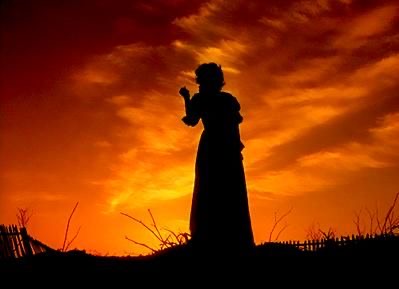
You may recognize the woman in the photo above. Miss Scarlet is a perfect example of “The stiff-necked ‘I’. It is a figurative way of speaking of man’s self-will and stubbornness, shown especially in his unwillingness to admit himself wrong” (Roy Hession).
“The Bent C,” however, reflects a completely different demeanor. Roy Hession says, “A ‘C’ is simply a bent ‘I.’ Humility bends the will!” In the picture below, notice the woman’s posture forms the shape of a C.

“If we are to come into a right relationship with Christ, the first thing we must learn is that our wills must be broken to His will. To be broken is the beginning of Revival. It is painful, it is humiliating, but it is the only way. It is being ‘Not I, but Christ.’ The Lord Jesus cannot live in us fully and reveal Himself through us until the proud self within is broken” (Roy Hession).
“The sacrifices of God are a broken spirit; a broken and a contrite heart,
Psalm 51:17 (NASB95)
O God, You will not despise.”
The “Bent C” is characterized by dying to self and saying “Yes Lord.” We said it once at salvation, but as we grow in Christ, we find ourselves saying it more often, even several times a day. This is how the character of Christ is formed in us as we yield to Him.

The picture above shows a blacksmith hammering iron. God often uses trials to accomplish this – not to harm us, but to make us pliable. “Like a blacksmith shaping iron, He softens us so He can form Christ in us. The hard, stiff iron cannot be molded and shaped until it is placed in the fire” (Spiros Zodhiates). 1 Peter 5:6-7 says, “Therefore humble yourselves under the mighty hand of God, that He may exalt you at the proper time, casting all your anxiety on Him, because He cares for you” (NASB95).
What is God trying to do in your life that you’re resisting? I like to think of His mighty hand as anything He allows in our lives to make us more like Christ. Instead of standing with our fist in defiance to heaven, the attitude of Christ humbly says, “Not my will but Thine be done.”
“Do nothing from selfishness or empty conceit, but with. humility of mind regard one another as more important than yourselves; do not merely look out for your own personal interests, but also for the interest of others. Have this attitude in yourselves which is also in Christ Jesus, who, although He existed in the form of God, did not regard equality with God a thing to be grasped, but emptied Himself, taking the form of a bond-servant, and being made in the likeness of men. Being found in appearance as a man, He humbled Himself by becoming obedient to the point of death, even death on a cross.”
Philippians 2:3-8 NASB95 (emphasis added)
This posture of humility glorifies God and keeps our lanterns full. Every word, thought, and action matter in eternity. God will honor every moment that we humble ourselves and say “Yes Lord.” We must “be diligent to be found by Him in peace, spotless and blameless” (2 Peter 3:14 NASB95).
When we choose to die to self, our posture changes from the stiff-necked I to the Bent C, and something else shifts too – our perspective.
Our Perspective: Living in Light of Eternity
When our hope is anchored in Christ’s return, Scripture tells us it changes how we see life. Our hearts are purified, our priorities reshaped, and our perspective transformed in three ways:
- We Fix our Eyes on Jesus: Christ becomes our focus – not our circumstances. When our eyes are fixed on Him, we’re able to run the race with endurance as Hebrews 12:1-2 states.
- We Trust God’s Patience and Timing: 2 Peter 3:9 speaks to this. What feels like delay to us is actually mercy. God is not absent – He is patient with us, not wanting any to perish, but for all to come to repentance.
- We Rest in God’s Promises: Our God is a promise keeping God! The apostle Peter tells us that in the last days, mockers will come (2 Peter 3:3-4). But every prophecy of His first coming was fulfilled in mind-blowing accuracy. We should not lose heart, but be confident that what He says, He will do! Jesus is coming again, and He is faithful to every word He has spoken.
“Behold, I am coming quickly, and My reward is with Me, to render every man according to what He has done. I am the Alpha & Omega, the first & the last, the beginning & the end.”
Revelation 22:12 (NASB95)
“These are the words of King Jesus. Count on them. Take them to the bank. Live every day in light of them. Make every choice in light of Christ’s certain promises. We were all made for a person and a place. Jesus is the person. Heaven is the place” (Randy Alcorn, Heaven).
One of my favorite pastimes is watching for deer in the woods behind my house. I am constantly amazed at how they hide in plain sight, and if I’m not attentive, I miss them entirely. In the same way, I want to live intentionally, faithfully watching for the Lord’s return – with longing.

The Psalmist wrote in Psalm 42:1-2, “As the deer pants for the water brooks, so my soul pants for You, O God. My soul thirsts for God, for the living God; When shall I come and appear before God?” (NASB95). Are you longing for Him today? Are you ready to meet Him? Do you know for sure that you are in Christ? Are you walking in the Spirit, abiding in Him? Do you have a posture of humility, saying “Yes Lord”? Are you resting in His promises? This is how to become believers with full lanterns.


Steph:
Is it possible to get your previous Simply Persuaded posts?
John
LikeLike
Hey! Yes, you should be able to! I think others have had a similar problem. I’m going to work on it and let you know!
LikeLike
Hey John, if you go to http://www.simplypersuaded.blog, you should be able to see all my posts (just scroll down and you’ll see them).
LikeLike
I got them all and kept them but computers seem to be invaded by demons….I have to rebuke them annually!
thanks a million,
John
LikeLike
LOL!! You’re welcome!!
LikeLike