
I can’t believe we made it to our last week of study. What an absolute joy it has been to dive deep into the names of God with you. I feel like He has orchestrated every detail of this study, not only in the timing and order of the names, but in the relevance they’ve had to me personally in this season of my life. I hope God has ministered to your heart through the refuge of His powerful name. What a perfect name to end on, Jehovah-Shammah: The LORD is There.
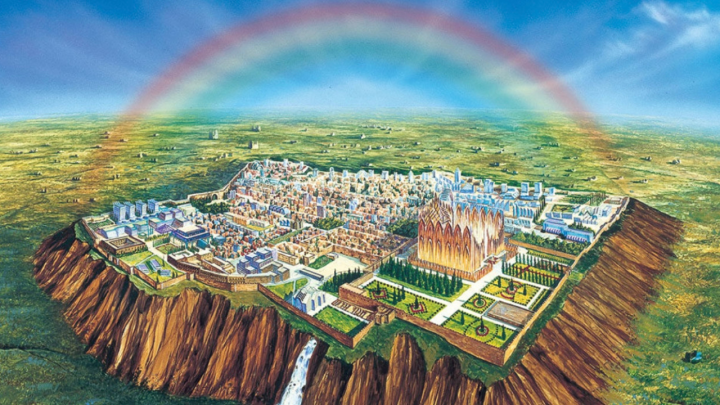
“In the last verse in the great prophecy of Ezekiel, we find the last new name of God in the Old Testament, a fitting name to bring the Old Testament revelation to a climax. The NEW NAME Jehovah-Shammah is strictly speaking of God’s new name for Jerusalem, and this new name reflects the identification of the Place with the Person and Permanent Presence of the Prince of Peace, the Messiah (Isaiah 9:6). In short, the city will then take on the same characteristics as the LORD who will dwell within her. God’s presence is made unforgettable in the very name of the new city, ‘The LORD is There‘” (preceptaustin, emphasis added). Check out this post for further study on the Millennial City.
“The distance around the entire city will be 6 miles. And from that day the name of the city will be ‘The LORD is There‘ [Jehovah Shammah].”
Ezekiel 48 35 NLT
Ezekiel’s prophecy is more completely understood through a comprehensive look at the history of Israel, culminating in the book of Ezekiel. “According to Irving Jensen, the book of Ezekiel can be divided into two main parts: Chapters 1-32 could be titled ‘Jehovah Not There’ and chapters 33-48 titled ‘Jehovah There'” (Kay Arthur, Lord I Want to Know You, p. 172). As we will see, the glory of God left the Temple in the first half of Ezekiel, but in the last half, we discover that Jehovah Shammah will not reject His people forever and promises to one day return and personally dwell among them.
The reason for the tragic and abrupt exit of God’s glorious presence was the sin of idolatry. After all God had done for Israel, the people continued to disregard Him and take His presence for granted, looking to idols instead. The glory of God’s presence cannot and will not be shared with idols (Isaiah 42:8). From the very beginning of our study, we’ve seen how God has intentionally chosen to reveal Himself to us through His Word. He disclosed His character through His names to ordinary people in extraordinary circumstances that tested their faith. Would they trust that God was truly who He claimed to be? Will we do the same?
God’s desire to communicate and dwell with His people is a theme throughout Scripture. It can be traced all the way back to the Garden of Eden when God walked in personal communion with Adam and Eve in the cool of the day. Elohim desires a relationship with those He created. Sadly, sin drove man away from God, but it didn’t stop God from pursuing him. One of the clearest pictures of His presence with Israel was the pillar of cloud by day and fire by night that led them through the wilderness after their deliverance from Egypt. The cloud and fire eventually settled on the mercy seat of the Ark of the Covenant in the Tabernacle, the place where God dwelt.
“Let them construct a sanctuary for Me, that I may dwell among them.”
Exodus 25:8 NASB95
The word “tabernacle” literally means “dwelling place.” The Holy of Holies contained the Ark of the Covenant, where God’s presence, manifested as cloud and fire, resided continually. This glorious presence is also known as the Shekinah Glory, “the visible manifestation of the presence of God. It is the majestic presence or manifestation of God in which He descended to dwell among men. Whenever the invisible God becomes visible, and whenever the omnipresence of God is localized, this is the Shekinah Glory” (Arnold Fruchtenbaum). “The Angel of the LORD is associated with the Shikinah pillar of cloud and fire (Exodus 23:20-22, Isaiah 63:9, Precept Austin).
The Shekinah Glory tabernacled among the people for almost 800 years! I was amazed when I realized its timeline (40 years in the wilderness Tabernacle, 7 years at Gilgal, 369 years at Shiloh, and 365 years in Solomon’s Temple). Throughout this period, Israel fell into the sin of idolatry, the kingdom split (Southern Kingdom: Judah and Northern Kingdom: Israel), and the people of God played the harlot with pagan idols. After about 500 years of the divine Presence dwelling with the people, God sent His prophets to warn them of coming destruction if they did not repent from their idolatrous behavior. These prophets urgently warned the people for approximately 278 years! Israel was taken by the Assyrians 148 years into the 278-year prophetic period, leaving 130 years of continued prophetic activity (mostly concerning Judah) until Ezekiel’s vision in 592 BC.
Ezekiel’s vision revealed a heartbreaking and dramatic scene of the Shekinah Glory leaving Solomon’s Temple (Ezekiel 10). Not long after, Babylon invaded the Southern Kingdom of Judah. Starting with the 607 BC invasion, the Babylonian invasions of Judah spanned approximately 21 years, with the final siege of Jerusalem lasting about 18 months, culminating in the destruction of Solomon’s Temple. As for the Ark of the Covenant, we know it was present at the dedication of Solomon’s Temple (365 years earlier), but no one knows for sure where it went or when it disappeared. If the Ark of the Covenant was hidden during King Josiah’s reign, it could have been missing for up to 35 years before the Temple was destroyed. It does not appear in the Babylonian plunder lists in 2 Kings 25, 2 Chronicles 36, or Jeremiah 52. Ezekiel’s vision doesn’t mention the Ark, suggesting it may already have been absent.
Judah remained in captivity for a total of seventy years, as prophesied in 2 Chronicles, Daniel, and Jeremiah. As previously mentioned, the Northern Kingdom of Israel was exiled earlier by the Assyrians in 722 BC (148 years before the Babylonian captivity of Judah) and largely assimilated, becoming known as the “Ten Lost Tribes,” with no significant return to their homeland. I am stunned at the devastation their idolatry caused!
In Ezra 1:1, Cyrus’ decree marks the end of the captivity and the return of the people as prophesied by Jeremiah. Ezra 3:1-3 speaks of the unity of the people and the importance they placed on repentance. The very first thing they did under Jeshua and Zerubbabel’s leadership was to rebuild the altar and restore sacrifice, the only means they had of maintaining a right relationship with God. As the Temple restoration began, there were mixed reactions from the people. Once the foundation was laid, there was a great eruption of praise to God! “But many of the older priests, Levites, and other leaders who had seen the first Temple wept aloud when they saw the new Temple’s foundation. The others, however, were shouting with joy. The joyful shouting and weeping mingled together in a loud noise that could be heard far in the distance” (Ezra 3:12-13 NLT).
Soon after the foundation was laid, enemies opposed the rebuilding, and the people were discouraged and frightened. This resulted in a 16-year delay in building, with the 2nd Temple finally completed in 515/516 BC. Based on Ezra, Israel likely continued making sacrifices during the halt in Temple construction. In some ways, I can understand the mix of emotions the people had about rebuilding the Temple. As wonderful and glorious as it was, there was one very important thing missing: the Shekinah Glory of God! Remember, it had left Solomon’s Temple roughly 75 years earlier.
“Does anyone remember this house – this Temple – in its former splendor? How, in comparison, does it look to you now? It must seem like nothing at all! But now the LORD says: Be strong, Zerubbabel. Be strong, Jeshua, son of Jehozadak, the high priest. Be strong, all you people still left in the land. And now get to work, for I am with you, says the LORD of Heaven’s Armies [Jehovah Sabaoth]. My Spirit remains among you, just as I promised when you came out of Egypt. So do not be afraid.”
Haggai 2:3-5 NLT
What wonderful encouragement to the people! Although the physical presence of the Shekinah Glory seen in the cloud and fire had been removed from them, God’s Spirit graciously remained and would strengthen them to do the work. God continued to speak through the prophet Haggai and said in Haggai 2:9, “The future glory of this Temple will be greater than its past glory, says the LORD of Heaven’s Armies [Jehovah Sabaoth]. And in this place I will bring peace. I, the LORD of Heaven’s Armies [Jehovah Sabaoth], have spoken!” (NLT).
Jerusalem’s walls weren’t rebuilt until around 445 BC when Nehemiah returned. The returnees were primarily from Judah’s Babylonian exile, not Israel’s Assyrian exile. There’s no evidence of a large-scale return of Northern Israelites, though some individuals may have joined Judah over time. Temple service had resumed, and life in Jerusalem was being reestablished. God continued to speak to His people through the prophets Ezra, Nehemiah, Haggai, Zechariah, and Malachi, but there was no ark or Shekinah glory behind the veil. From the year the temple was rebuilt (515 BC) to the end of Malachi’s prophecies in the Old Testament was about 85 years. And then, silence. This silence must have been deafening! Would God’s glory ever return to the temple? To His people? 400 years went by, and Israel, along with the rest of the world, was battered by war and chaos. But one solitary night in the town of Bethlehem, the silence was broken by a Baby’s cry!
Haggai’s prophecy about the glory of the Second Temple being greater than Solomon’s Temple would come to pass when Mary and Joseph brought baby Jesus to the Second Temple when He was just 8 days old. Simeon praised God saying, “Now Lord, You are releasing Your bond-servant to depart in peace, according to Your word; for my eyes have seen Your salvation, which You have prepared in the presence of all peoples, A LIGHT OF REVELATION TO THE GENTILES, and the glory of Your people Israel” (Luke 2:30-32 NASB95).
Many received Jesus, but many more rejected Him. Sadly, “the people did not put to good use either the fulfilled prophecies nor the 400 years the nation was given to study Scripture, to seek God (Psalm 43-45), and to prepare for the coming Messiah. In fact, those years blinded and deafened the nation to the point where most of the Jews could not even consider the concept of a humble Messiah (Zech. 9:9; Is. 6:10; John 12:40, gotquestions).” The Second Temple was eventually destroyed in awful destruction by Titus the Roman in AD 70 as prophesied in Daniel 9:26 and Luke 19:41-44. But despite Israel’s unbelief, our God is a covenant-keeping God!
Jesus is coming again and “promised He would return to Jerusalem and that the name of Jerusalem would be Jehovah-Shammah, the LORD is there. When He returns, His word through Ezekiel to His people Israel will be fulfilled” (Kay Arthur, Lord I Want to Know You, p. 189, emphasis added). I am amazed at the long-suffering of God! He has a plan for Israel’s salvation, which will be brought about at the end of Daniel’s 70th Week, when Jehovah-Shammah will dwell with His people in a future Millennial Temple where God’s divine Presence will return (Ezekiel 43:1-10).
“Jehovah-Shammah will be the new name of Jerusalem, symbolizing the permanence of the LORD’s presence (Isaiah 7:14). Jehovah would never depart from Israel again and would never send them into exile again. The believing remnant of Israel and all Gentile believers would enjoy unbroken fellowship with God, even as Adam and Eve had in the Garden of Eden” (Genesis 3:8, Fruchtenbaum).
Until that glorious time, Jehovah-Shammah dwells within believers in the Person of the Holy Spirit, and promises to never leave us or forsake us (Hebrews 13:5). He is with us as we anxiously await “the blessed hope and the appearing of the glory of our Great God and Savior, Christ Jesus” (Titus 2:13 NASB95), and His imminent return for us at the rapture.
“For this we say to you by the word of the Lord, that we who are alive and remain until the coming of the Lord, will not precede those who have fallen asleep. For the Lord Himself will descend from heaven with a shout, with the voice of the archangel and with the trumpet of God, and the dead in Christ will rise first. Then we who are alive and remain will be caught up together with the Lord in the air, and so we shall always be with the Lord. Therefore comfort one another with these words.”
1 Thessalonians 4:15-18 NASB95
As we close, I would be remiss if I did not emphasize the impact of idolatry on a believer’s experience of the presence of God. Although we are never separated from the Spirit’s indwelling, we can forfeit the closeness of His presence in our relationship with Him because of idolatry.
“An idol is not only a heathen image; the literal significance of the word ‘idol’ is ‘what is seen’; it signifies not only that which would engage the attention of the physical eyesight, to the detriment of the use of our spiritual faculties, but also any false conception which would engross the mind to obscuring the vision of faith. We are to guard ourselves against everything that would mar the spiritual life which Christ would live out in us, everything of self which would interrupt the power and effect of that life, every teaching which masquerades as truth, but which on a spiritual examination is found to contain that which is contrary to Scripture, and therefore denies in any measure the attributes of God, the one God, Father, Son and Holy Spirit (Vine’s Expository Dictionary, emphasis added).
When someone is worshiping an idol, the Bible warns that they will become like their idol, incapable of spiritual sight, hearing, or speaking the truth (Psalm 115:3-18, Matthew 13:15). The root of all idols “is the idol of self. The idolator has not yielded the throne of his life to the true God. Rather, he wants his will and his way, and he tries to use God to get what he wants” (Bible.org). “Whenever we look for answers apart from God – consciously or subconsciously – we pursue a false god. It would be wise to ask ourselves: what idols, literal or figurative, do we need to throw on the fire?” (preceptaustin). If we want to experience God’s presence fully through the revelation of His names, we must consider this and be intentional about guarding our hearts. “Little children, guard yourselves from idols” (1 John 5:21 NASB95).
“Now, little children, abide in Him, so that when He appears, we may have confidence and not shrink away from Him in shame at His coming.”
1 John 2:28 NASB95
Week 8 Reflections
Day One: Shekinah Glory
- Read the following passages in Exodus and Isaiah. Note what you learn about God’s divine Presence with Israel: Exodus 13:20-22; Exodus 23:20-22; Exodus 33:12-16; Exodus 40:34-38. What do you learn from Isaiah 63:9?
- Read Ezekiel 8:3-6, 17-18 and note God’s reaction, specifically in verse 6.
- Read Ezekiel 10; 11:22-25 and record what you learn about God’s Shekinah Glory leaving the Temple. “Can you sense the Lord’s reluctance in leaving His temple, His city where He had set His name? Do you see Him lingering, longingly waiting for her cry of repentance?” (Kay Arthur, Lord I Want to Know You, p. 184).
Day Two: Idolatry
- Read the following passages and record what you learn: Exodus 20:1-6; Exodus 34:14 (notice another name of God we didn’t study, Jehovah– Qanna); Ezekiel 6:1-6.
- Pick 4 or 5 of the following verses and record what you learn about idolatry: Psalm 16:4; Psalm 115:1-11; 1 Samuel 15:23; Jeremiah 11:12; 1 Corinthians 10:7; Habakkuk 2:18-20; 1 Corinthians 5:11; Matthew 6:24; 1 Corinthians 10:14; Colossians 3:5; 1 John 5:21; 1 Thessalonians 1:9-10; Romans 10:3-4; Galatians 5:19-21.
- Although these verses don’t speak directly about idols, what can you glean from them about guarding your heart from idolatry? Phil. 3:7-8; Colossians 3:1-2; Psalm 75:25-28; John 15:4-5; Titus 2:11-13; James 1:21; Hebrews 2:1.
Day Three: Jehovah Shammah
- Read Ezekiel 43:1-12. What do you learn about God’s glory returning to the Millennial Temple? The promise of Jehovah-Shammah (the new name of the city signifying God’s eternal presence) is found in Ezekiel 48:35. If you have time, read Ezekiel 48:1-34 and record anything that stands out to you about the city.
- What promise do you see in Jesus’ name, Immanuel, that relates to Jehovah-Shammah, in Isaiah 7:14?
- How does 1 Thessalonians 4:15-18 encourage you in light of what you’ve learned about Jehovah-Shammah?
- What do the following passages show you about the promise and importance of the nearness and presence of God? Exodus 33:14-15; Psalm 73:25; James 4:8; Psalm 145:18; Ephesians 2:13; Psalm 16:8; Hebrews 10:22; Isaiah 41:10; Isaiah 43:2; 1 Corinthians 3:16; Matthew 28:20; Rev. 22:3-5.
Journal Prompts
Is there anything about this week’s study that touched your heart? How important is the nearness of God to you? Have you drifted away from the truth because of self-focus? Are there any idols in your life? Is there any part of Scripture you are not willing to submit to or obey? How does it encourage your heart to know that Jesus will never leave you or forsake you? Are you desiring to know Him more? Think about all the names of God you’ve learned. Which one is your favorite? How have you learned to run to Him as your refuge and strong tower?
The dearest idol I have known,
Whate'er that idol be,
Help me to tear it from Thy throne,
And worship only Thee.

William Cowper
 Simply Persuaded
Steph:
By God’s Divine Providence you have shared today exactly what I am studying. God Bless You for this great message. You have no idea what it means to me!!!!!
John
LikeLiked by 1 person
Oh wow that’s amazing! I love it!!! Thank you so much for sharing that with me! God bless you in your studies!! ❤️
LikeLike