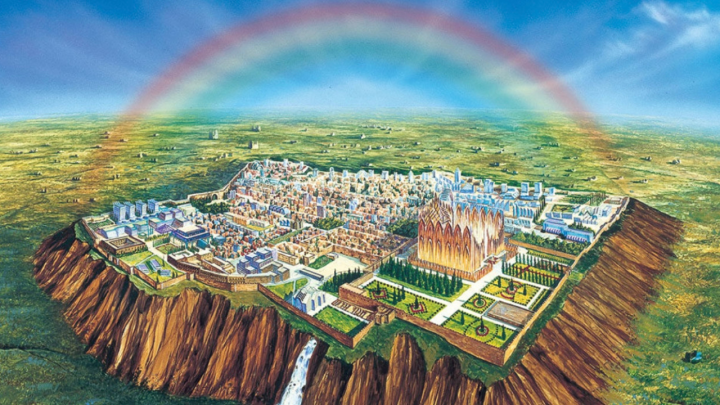
“At the time of the second coming of Messiah, the land will undergo some tremendous geographical and topographical changes. One of the key transformations will be the rise of a mountain that will become the highest mountain of the world. On its summit will stand the Millennial Temple and the Millennial Jerusalem.”
Fruchtenbaum, The Footsteps of the Messiah, p. 430-431
The term “mountain” in Scripture could be taken figuratively “as a symbol of a kingdom” or literally as a geographical location. We know the Millennial Kingdom will be exalted above all other kingdoms in the world. “The reference to ‘the mountain of the house of Yahweh (Isaiah 2:2), however, may indicate that the prophet had a more literal meaning in mind. He may have meant that the actual mountain on which the temple stood would be thrust higher in elevation” (Constable, Precept Austin). Given the worldwide earthquake that is prophesied to occur at the Second Coming of Christ and subsequent geographical changes that occur in the world and specifically Jerusalem, I believe the term “mountain” not only represents a kingdom but also a literal, geographical mountain where the Millennial Temple and Millennial Jerusalem will dwell (see Rev. 16:17-21; Zech. 14:4b-5).
“It shall come to pass in the latter days that the mountain of the LORD’s house will be [firmly] established as the highest of the mountains and shall be exalted above the hills, and all nations shall flow to it.”
Isaiah 1:2 AMP
Micah 4:1-2 repeats this prophecy. Precept Austin says, “In view of the truth that ALL Scripture is God-breathed (2 Tim. 3:16) and that the Holy Spirit moved in men of old to speak God’s word (2 Peter 1:21), this repetition in Isaiah and Micah emphasizes the supreme importance of this great truth concerning Jerusalem’s future” (Precept Austin).
Zechariah describes the lifting of the city in Zechariah 14:10, “All the land shall be turned into a plain from Geba to Rimmon south of Jerusalem. Jerusalem shall be raised up and inhabited in her place from Benjamin’s Gate to the place of the First Gate and the Corner Gate, and from the Tower of Hananel to the king’s winepresses.” The phrase “raised up” is a “verb meaning to rise, to be lifted up. It refers to something being raised high above other things. It refers to Jerusalem’s exalted place in the era of God’s Great King” (Zodhiates, CWSB, H7213).
Ezekiel 17:22-24 describes the “mountain of the height of Israel” as “a place of lush greenery and vegetation” (Fruchtenbaum, The Footsteps of the Messiah, p. 432). According to Ezekiel 20:40-41, the Millennial Mountain of the Lord (also known as Mount Zion) will be a place of worship hallowed in Israel before the Gentiles. Fruchtenbaum notes that Ezekiel (in Ezekiel 40:1-2) saw the skyline of Millennial Jerusalem on the south side of the Millennial Mountain (The Footsteps of the Messiah, p. 433).
“In the twenty-fifth year of our captivity, at the beginning of the year, on the tenth day of the month, in the fourteenth year after the city was captured, on the very same day the hand of the LORD was upon me; and He took me there. In the visions of God He took me into the land of Israel and set me on a very high mountain; on it toward the south was something like the structure of a city.”
Ezekiel 40:1-2
I love Fruchtenbaum’s literal approach to biblical interpretation. I feel it is important to interpret God’s Word literally whenever contextually possible. Ezekiel 45:1-8 reveals “that on top of this very high mountain will be a fifty-mile square plateau (v. 1). This plateau will be subdivided into three sections” (Fruchtenbaum, The Footsteps of the Messiah, p. 434). The three sections can be divided as follows: (see also Ezekiel 48:8-20).
- The Northern Section (Ezekiel 45:2-4): This section is 20 x 50 miles, “having its center the Millennial Temple, which will be about one-mile square. The rest of the area of the northern section will be reserved for the Zadokites to live. These are the priests, the ministers of the sanctuary, that come near to minister unto Jehovah” (Woodhead). Ezekiel 48:9-12 adds more detail about the northern section. Fruchtenbaum says the descendants of Zadok are “the segment of the tribe of Levi that remained faithful while the rest went astray (v. 11-12)“ (The Footsteps of the Messiah, p. 436, emphasis added).
- The Central Section (Ezekiel 45:5): This area is also 20 x 50 miles “and will be reserved for the members of the Tribe of Levi” (Fruchtenbaum, The Footsteps of the Messiah, p. 435).
- The Southern Section (Ezekiel 45:6-8): “will be 10 miles by 50 miles, the smallest of the three” (ibid). Fruchtenbaum goes on to say, “In the center of the southern section will stand the Millennial Jerusalem, measuring 10 x 10 miles. On either side of the city will be field areas, each measuring 10 by 20 miles, for growing food” (The Footsteps of the Messiah, p. 435).
“Again, Ezekiel states that the total size of this section of the mountain of Jehovah’s house is to be fifty miles square. It will be the holy oblation upon which both the Temple and Jerusalem will sit (Ezekiel 48:20).”
Fruchtenbaum, The Footsteps of the Messiah, p. 436
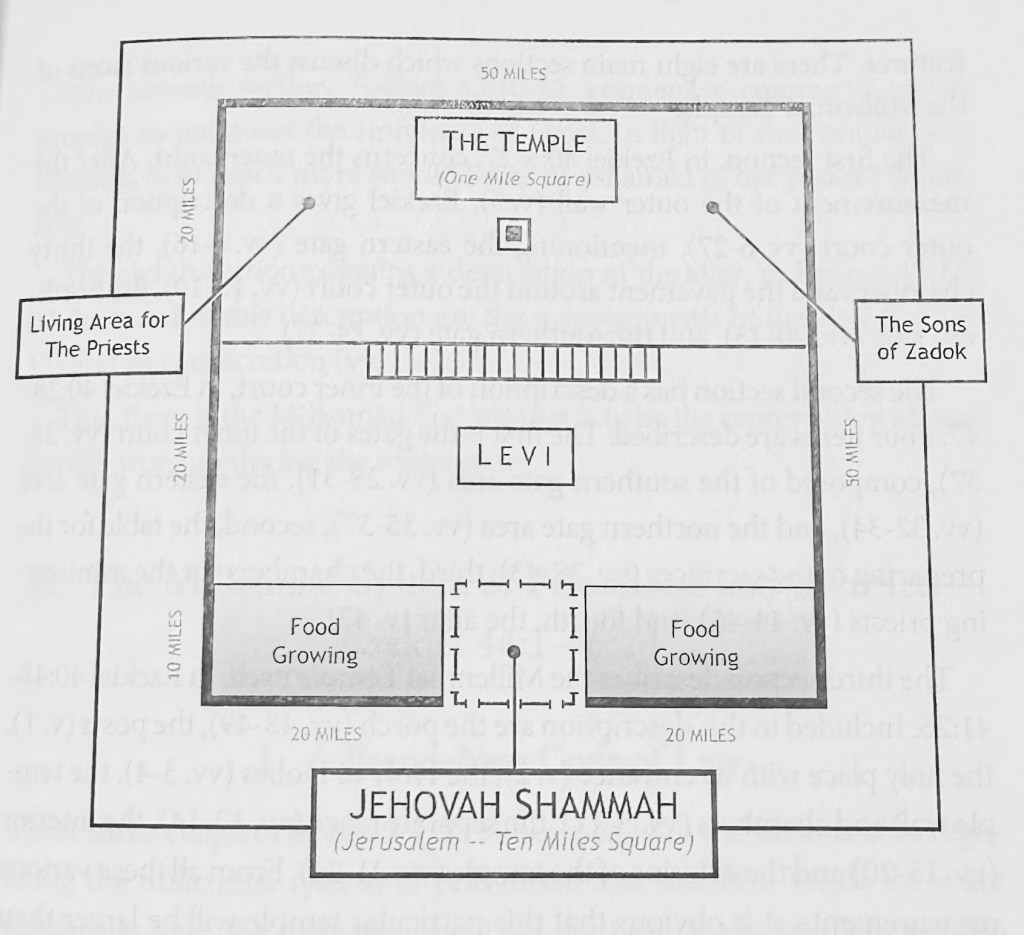
The Millennial Mountain of Jehovah will have a Millennial city. As stated above, the Millennial city of Jerusalem will be located in the center of the southern section, measuring 10 by 10 miles. “She is to have twelve gates, three on each side, each named after a tribe of Israel (Ezekiel 48:30-34). The primary purpose of these gates is revealed in Isaiah 60:11-12“ (Irvin). “Your gates shall be open continually; day and night they shall not be shut, that people may bring to you the wealth of the nations, with their kings led in procession. For the nation and kingdom that will not serve you shall perish; those nations shall be utterly laid waste” (Isaiah 60:11-12).
“Thus says the LORD: ‘I will return to Zion, and dwell in the midst of Jerusalem. Jerusalem shall be called The City of Truth, The Mountain of the LORD of Hosts, the Holy Mountain.’ Thus says the LORD of hosts: ‘Old men and old women shall again sit in the streets of Jerusalem, each one with his staff in his hand because of great age. The streets of the city shall be full of boys and girls playing in its streets.'”
Zechariah 8:3-5
An interesting observation is that the men and women will be “of great age.” I am reminded of Isaiah 65:20-22 and how the believers in the Millennial kingdom are said to live long lives, possibly the full length of the Millennium.
Scripture gives many names to Millennial Jerusalem such as the city of righteousness, a faithful city (Isaiah 1:26); The Lord is our Righteousness (Jehovah Tsidkenu, Jer. 33:16); and the City of Truth (Zech. 8:3). “Because it is God who will establish Jerusalem, the city will be known as ‘the city of God,’ according to Psalm 87:1-7 (Fruchtenbaum, The Footsteps of the Messiah, p. 456).
My favorite name, however, is found in Ezekiel 48:35b, “and the name of the city from that day shall be: THE LORD IS THERE.” Jehovah Shamah (Hebrew for “The LORD is there”) is a name of God only used in Ezekiel 48:35. What a blessed name for Millennial Jerusalem where Immanuel, the Great I Am, Jesus Christ will take up residence and dwell among the people. Psalm 48 may portray Millennial Jerusalem as it “describes the city as the residence of the God of Israel” (Fruchtenbaum, The Footsteps of the Messiah, p. 454).
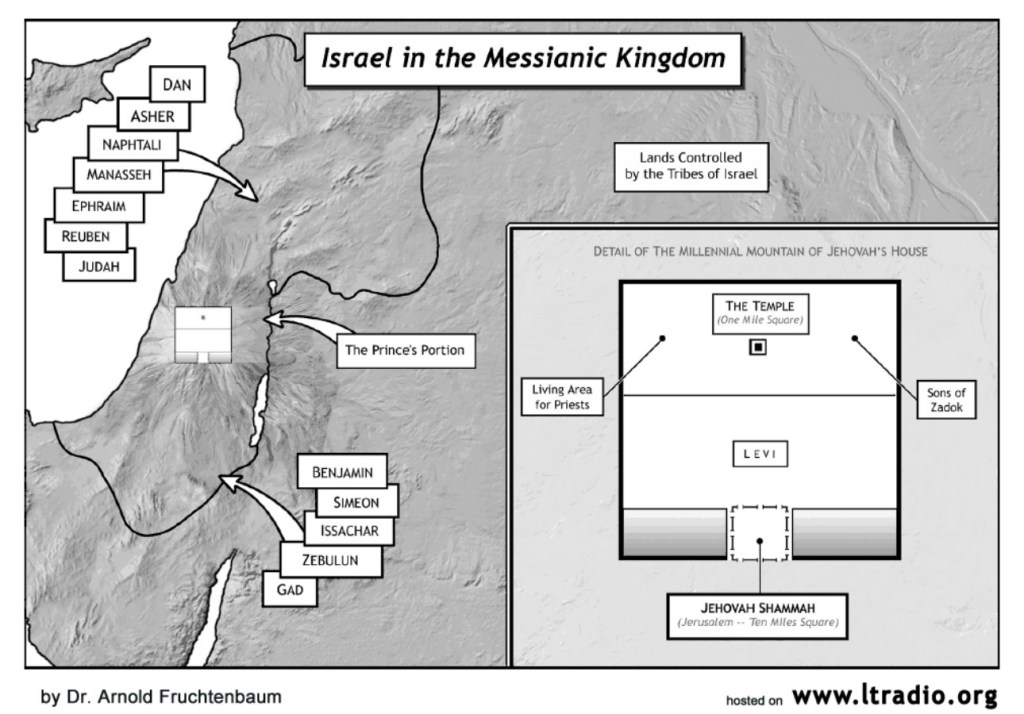
The Millennial Mountain of the LORD consists of the city of Jerusalem and the Millennial Temple, which we will discuss next week. The rest of Israel will be located adjacent to the mountain.“For the first time in Israel’s history, the Jews will possess and settle in all of the Promised Land. The nation will again be subdivided into twelve tribal regions. But these divisions will be different than those mentioned in the book of Joshua. Ezekiel 47:13-48:29 describes the nation during the Messianic kingdom” (Fruchtenbaum, The Footsteps of the Messiah, p. 452). The chart below shows Israel in the Messianic Kingdom.
Week 6 Homework Reflections:
- Read and compare Isaiah 1:1-2 and Micah 4:1-2. What do you learn?
- Read 1 Kings 1 and record what you learn about Zadok’s faithfulness. How do you see God rewarding the priestly line of Zadok for their faithfulness in the Millennial kingdom? (see Ezekiel 48:11)
- Read Isaiah 33:20-24 and describe what you learn about the city.
- Read Psalm 147 and record everything you see about God’s faithfulness to Zion.
- Read Ezekiel 48:35. Why will the city be called “The LORD is there?
- Now read Isaiah 7:14; 8:8; and Matthew 1:23. How does Jesus demonstrate the attributes of Jehovah Shammah to us as believers? Although we are not in the Kingdom yet, we have God’s kingdom in our hearts because of Christ’s Spirit who lives within us who believe. Read Romans 8:38-39 and John 14:16-17. What comfort does this give you as you wait for the blessed hope and glorious appearing of our great God and Savior Jesus Christ (Titus 2:13)?
 Simply Persuaded
One thought on “Part 4/Week 6: The Mountain of the LORD & Millennial Jerusalem”