
This week, we are looking at the second branch of the Millennial government, the Jewish branch. Fruchtenbaum does an amazing job of clarifying what this looks like. Here is his Messianic chain of command chart that I posted last week.
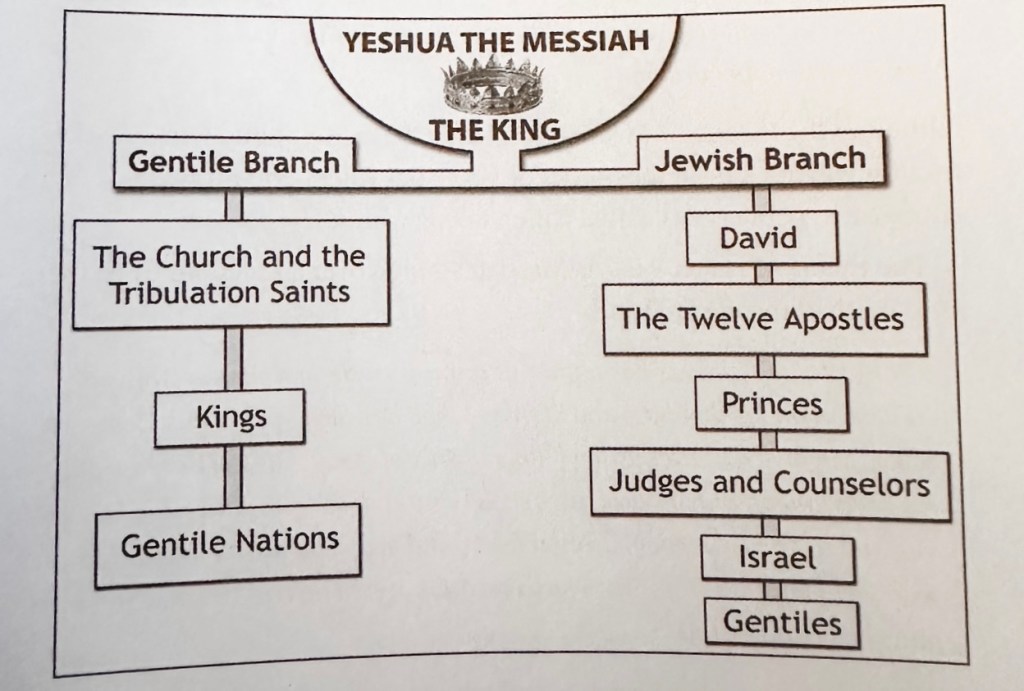
As pictured above, Fruchtenbaum believes that King David will have a prominent role in the Millennial government. He says, “Directly under the Messianic King, having authority over all Israel, will be the resurrected David, who is given both titles of king and prince” (The Footsteps of the Messiah, p. 388).
This is seen in several Old Testament prophecies (emphasis added):
- Jeremiah 30:9 “But they shall serve the LORD their God, and David their king, whom I will raise up for them.”
- Ezekiel 34:23-24 “I will establish one shepherd over them, and he shall feed them – My servant David. He shall feed them and be their shepherd. And I, the LORD will be their God, and My servant David a prince among them; I, the LORD have spoken.”
- Ezekiel 37:24 “And My servant David will be king over them, and they will all have one shepherd; and they will walk in My ordinances, and keep My statues, and observe them.”
- Hosea 3:5 “Afterward the children of Israel shall return and seek the LORD their God and David their king. They shall fear the LORD and His goodness for the latter days.”
Although these prophecies are clear in their mention of King David, are they referring to the literal, resurrected David or to his Seed, Christ? On the one hand, we know that Christ will be given “the throne of His father David, and He will reign over the house of Jacob forever, and His kingdom will have no end” (Luke 1:33). On the other hand, according to Daniel 12:13, we know that all Old Testament saints will be resurrected and receive their “allotted portion” in the Millennial kingdom. Interestingly, the Bible never refers to Christ as “David.” He is called the “Son of David” and the “Seed of David,” but never “David.” Precept Austin points out that in Jeremiah 30:9, the word for “raise up” is “anistemi” in the Septuagint and is the same Greek word used for “resurrection” in John 11:24 (when Martha told Jesus she knew Lazarus would “rise again in the resurrection (anistemi) on the last day). The use of this word in Jer. 30:9 indicates a resurrected King David ruling as king (Precept Austin).
“David is not the son of David. Christ, as the son of David, will be King; and David, His father after the flesh, will be prince, during the Millennium.”
William Newell (precept austin)
If these Scriptures are taken literally, we can conclude that King David, a man after God’s own heart, will one day be resurrected to rule and reign as a prince under the kingship of Christ. Not only will Christ fulfill the Davidic Covenant, but He will give King David a place in His miraculous government. King Jesus will be the Most High Sovereign King, ruling supremely over Israel and the rest of the world. But He will have under-shepherds (like David) serving with Him as the scepter of His righteous government reaches worldwide.
The next in the Jewish branch chain of command are the Twelve Apostles. Jesus promised them that they would one day rule over the twelve tribes of Israel.
- In Matthew 19:28, the rich young ruler walked away, and Peter asked Jesus what he and the other disciples would be given since they had left everything to follow Him. “Jesus replied, “I assure you that when the world is made new, and the Son of Man sits upon His glorious throne, you who have been My followers will also sit on twelve thrones, judging the twelve tribes of Israel” (NLT).
- In Luke 22:28-30, the disciples were arguing about who would be the greatest in the kingdom. Ironically, this conversation took place during the Last Supper. Jesus told them, “Those who are the greatest among you should take the lowest rank, and the leader should be like a servant” (v. 26). After identifying Himself as the servant, He continues in verses 28-30, “You have stayed with Me in My time of trial. And just as My Father has granted Me a Kingdom, I now grant you the right to eat and drink at My table in My Kingdom. And you will sit on thrones, judging the twelve tribes of Israel” (NLT). We know the apostles followed Jesus in taking “the lowest rank” as eleven of them were martyred, and John was exiled to the isle of Patmos.
“While [Messiah’s] rule will be over all the world and David’s over Israel, the apostles’ jurisdiction will be over particular tribes…Nothing is said as to which apostle is to rule over which tribe. The answer to that question awaits the fulfillment in the future kingdom.”
Fruchtenbaum, The Footsteps of the Messiah, p. 390
After our study last week, I am starting to see a common characteristic of those who rule and reign with Christ. Those who assume the lowest rank will be the greatest. Jesus said this knowing what He was about to do. He would display the glory of God by taking the lowest rank and dying on the cross, being identified with criminals.
The next in line under the Twelve Apostles will be Princes. This is seen in three main Old Testament Scriptures:
- Isaiah 32:1-2 “Look! A righteous king is coming! And honest princes will rule under him. Each one will be like a shelter from the wind and a refuge from the storm, like streams of water in the desert and the shadow of a great rock in a parched land” (NLT).
- Ezekiel 45:7-8 “Two special sections of land will be set apart for the prince. One section will share a border with the east side of the sacred lands and city, and the second section will share a border on the west side. Then the far eastern and western borders of the prince’s lands will line up with the eastern and western boundaries of the tribal areas. These sections of land will be the prince’s allotment. Then My princes will no longer oppress and rob My people; they will assign the rest of the land to the people, giving an allotment to each tribe” (NLT).
- Haggai 2:20-23 “On the same day, December 18, the LORD sent this second message to Haggai: ‘Tell Zerubbabel, the governor of Judah, that I am about to shake the heavens and the earth. I will overthrow the royal thrones and destroy the power of foreign kingdoms. I will overturn their chariots and riders. The horses will fall, and their riders will kill each other. But when this happens, says the LORD of Heaven’s Armies, I will honor you, Zerubbabel son of Shealtiel, my servant. I will make you My signet ring on my finger, says the LORD, for I have chosen you. I, the LORD of Heaven’s Armies, have spoken!” (NLT).
I love that Zerubbabel is prophesied to be one of Israel’s Millennial princes in Haggai 2:23. The use of the phrase “signet ring” denotes royal authority. The backstory to Zerubbabel is amazing. He was tasked with the rebuilding of the temple after the Babylonian captivity. However, because of the unbelief and negativity of the people, construction was halted for 17 long years. This must have devastated Zerubbabel. But God didn’t forget what He had called him to do and sent a word through Zechariah the prophet. “This is the word of the LORD to Zerubbabel: ‘Not by might nor by power, but by My Spirit,’ says the LORD of hosts” (Zech 4:6 NKJV). Zerubbabel took these words to heart. Once the work was started again, the temple was completed in just 3 years. Zerubbabel’s future role in the kingdom is secure. He will rule with Christ as one of His princes. Again, I see the common thread of surrender and trust in the Lord. When presented with an impossible task, Zerubbabel knew the work could only be done by the power of God’s Spirit in and through him.
The next group to be discussed in the Millennial government “chain of command” are Judges and Counselors. Isaiah 1:26 says, “I will restore your judges as at the first, and your counselors as at the beginning. Afterward you shall be called the city of righteousness, the faithful city” (NKJV).
The word “judges” refers to righteous judges of Israel’s past, such as Samuel, Deborah, and Gideon. We don’t know if they will judge Israel again in their resurrected bodies, but we know there will be righteous judges like them in the Millennial kingdom. “Counselors” refers to wise men like “Jethro (Moses’ father-in-law who advised Moses about how to judge the people of Israel (Ex. 18:19).” Wise men such as “Hushai and Ahithophel, [who] served as counselors to kings and other important people (2 Samuel 17:15; 1 Kings 12:9). Prophets also operated in this way (Jer. 38:15)” (Zodhiates, CWSB Dictionary H3289). I believe Messiah’s kingdom will have numerous judges and counselors who come alongside the people, offering wise counsel and holding official government positions.
The last group in the Jewish branch is Israel, as a nation ruling over the Gentiles. Fruchtenbaum says, “The fact that Israel is to become the head of the Gentiles was part of God’s promises to His people in the book of Deuteronomy” (The Footsteps of the Messiah, p. 391-392). “And the LORD will make you the head and not the tail; you shall be above only, and not be beneath, if you heed the commandments of the LORD your God, which I command you today, and are careful to observe them” (Deut. 28:13 NKJV). Knowing Israel’s history and rejection of the Messiah, you might be wondering how Israel will be given such a powerful place in the nations.
“For the LORD will have mercy on Jacob, and will still choose Israel, and settle them in their own land. The strangers will be joined with them, and they will cling to the house of Jacob.”
Isaiah 14:1 (NKJV)
Verse 2 says, “The nations of the world will help the people of Israel to return, and those who come to live in the LORD’s land will serve them. Those who captured Israel will themselves be captured, and Israel will rule over its enemies” (NLT). The promise of Israel ruling over the Gentiles can also be seen in Deut. 15:6; Isaiah 49:22-23; and Isaiah 61:6-7). Once again, I am filled with awe at the loving-kindness of our God. Even though two-thirds of Israel will perish in their rejection of the Messiah, God will save the remnant (Zech 13:8) and exalt them to become a world power. I believe Israel will rule over the Gentiles both nationally and domestically in that the Gentiles will serve them instead of the other way around.
“So the ransomed of the LORD will return and come with joyful shouting to Zion, and everlasting joy will be on their heads. They will obtain gladness and joy, and sorrow and sighing will flee away.”
Isaiah 51:1 NASB95
“The chain of command in the Jewish branch of government is from the Messianic King to David, to the twelve apostles, to the princes, to the judges and counselors, over all Israel, which will be serving as the head of the Gentiles. Hence, the rod of iron that will characterize the rule of the government in the kingdom will be implemented through various spheres and positions of authority,”
Fruchtenbaum, The Footsteps of the Messiah, p. 392
Week 5 Homework Reflections
- Read Jeremiah 30:9; Ezekiel 34:23-24; Ezekiel 37:24; and Hosea 3:5. What do these Scriptures say about King David?
- Read Matthew 19:16-30 and Luke 22:14-30. What insights do you get from the context of these two passages? What qualified the apostles to judge the twelve tribes of Israel?
- Read Isaiah 32:1-2; Ezekiel 45:7-8; and Haggai 2:20-23. List everything you learn about the princes of the Kingdom. What truths do you learn about Zerubbabel?
- Read Isaiah 1:26 and describe what you learn about the judges and counselors God will use during the Millennial kingdom. What will the city be called at this time?
- Read Isaiah 49:22-23 and 61:6-9. What does God’s kindness to Israel reveal about His character? How does that speak to your heart?
- Lastly, what common characteristics do you see in King David, the Twelve Apostles, and Zerubbabel?
 Simply Persuaded