“That the Messiah is to sit upon the throne of David and rule in a kingdom over Israel with a dominion extending over all the Gentiles is the clear teaching of the Old and New Testaments.”
Fruchtenbaum, The Footsteps of the Messiah, p. 379
During the Millennial kingdom, Christ will be King over all the earth, not just Israel. Zechariah 14:9 states, “And the LORD will be king over all the earth. On that day there will be one LORD – His name alone will be worshiped” (NLT).
As we look toward the Kingship of Christ in His Millennial reign this week, I am reminded of when the nation of Israel came to Samuel demanding a king. 1 Samuel 8:5 says, “Look,’ they told him, ‘you are now old, and your sons are not like you. Give us a king to judge us like all the other nations have” (NLT).
This request disturbed Samuel greatly and he immediately took it to the LORD who replied, “Do everything they say to you, for they are rejecting Me, not you. They don’t want Me to be their king any longer. Ever since I brought them from Egypt they have continually abandoned Me and followed other gods. And now they are giving you the same treatment. Do as they ask, but solemnly warn them about the way a king will reign over them” (1 Samuel 8:7-9 NLT). Samuel tried to warn them but they refused to listen. “Even so, we still want a king…We want to be like the nations around us. Our king will judge us and lead us into battle” (1 Samuel 8:19-20 NLT).
This rejection of God was also a rejection of who He had called His people to be. God didn’t want them to be like other nations. He delivered them from Egypt to be a nation set apart unto Himself. He alone wanted to lead them and be their King. However, He had mercy on them (1 Sam. 9:16) and gave them their wish. After Saul’s anointing as king, Samuel gave a grim message from God to the people. “This is what the LORD, the God of Israel, has declared: I brought you from Egypt and rescued you from the Egyptians and from all of the nations that were oppressing you. But though I have rescued you from your misery and distress, you have rejected your God today and have said, ‘No, we want a king instead!” (1 Samuel 10:18-19a NLT).
The early days of Saul’s reign were full of promise and success. Sadly, it went to his head, and he did what was right in his own eyes. As a result, God took the kingdom away from him. When Samuel rebuked Saul for his actions, he said, “But now your kingdom must end, for the LORD has sought out a man after His own heart. The LORD has already appointed him to be the leader of His people, because you have not kept the LORD’s command” (1 Samuel 13:14 NLT). God knew the hearts of the people when they selfishly demanded a king. He also knew the kind of king they needed. A man after His own heart. A man who would foreshadow the future reign of Christ on the earth.
Although David wasn’t perfect, through all his shortcomings he maintained a repentant heart (see Psalm 51). He loved God more than anything else! David’s pliable heart to the LORD and His Word qualified Him to be the leader of God’s people. God loved this about David and made a covenant with him known as the Davidic Covenant. This covenant “refers to God’s promises to David through Nathan the prophet and is found in 2 Samuel 7 and later summarized in 1 Chronicles 17:11-14 and 2 Chronicles 6:16. This is an unconditional covenant made between God and David through which God promises David and Israel that the Messiah (Jesus Christ) would come from the lineage of David and the tribe of Judah and would establish a kingdom that would endure forever. The Davidic Covenant is unconditional because God does not place any conditions of obedience upon its fulfillment. The surety of the promises made rest solely on God’s faithfulness and does not depend at all on David or Israel’s obedience” (got questions).
It was through David’s line that God would bring the ultimate King Jesus to an everlasting Kingdom. What mercy of God to bring this about, and as we will see, include us in it! Despite Israel’s rejection of God, King David was a forerunner to God’s ultimate plan to bring His people salvation through Messiah King.
“For a child will be born to us, a son will be given to us; and the government will rest on His shoulders; and His name will be called Wonderful Counselor, Mighty God, Eternal Father, Prince of Peace. There will be no end to the increase of His government or of peace, on the throne of David and over His kingdom, to establish it and to uphold it with justice and righteousness from then on and forevermore. The zeal of the LORD of hosts will accomplish this.”
Isaiah 9:6-7 NASB95
This passage contains rich details of the type of government Christ will lead. Messiah’s reign will be full of righteousness, peace, faithfulness, justice, and glory (see Psalm 72 and Isaiah 11:5). Fruchtenbaum describes the chain of command in Messiah’s government as “being split into two branches: a Jewish branch of government and a Gentile branch, each in turn having a chain of command” (The Footsteps of the Messiah, p. 379). He includes this chart that is really helpful in visualizing the Messianic government (p. 379).
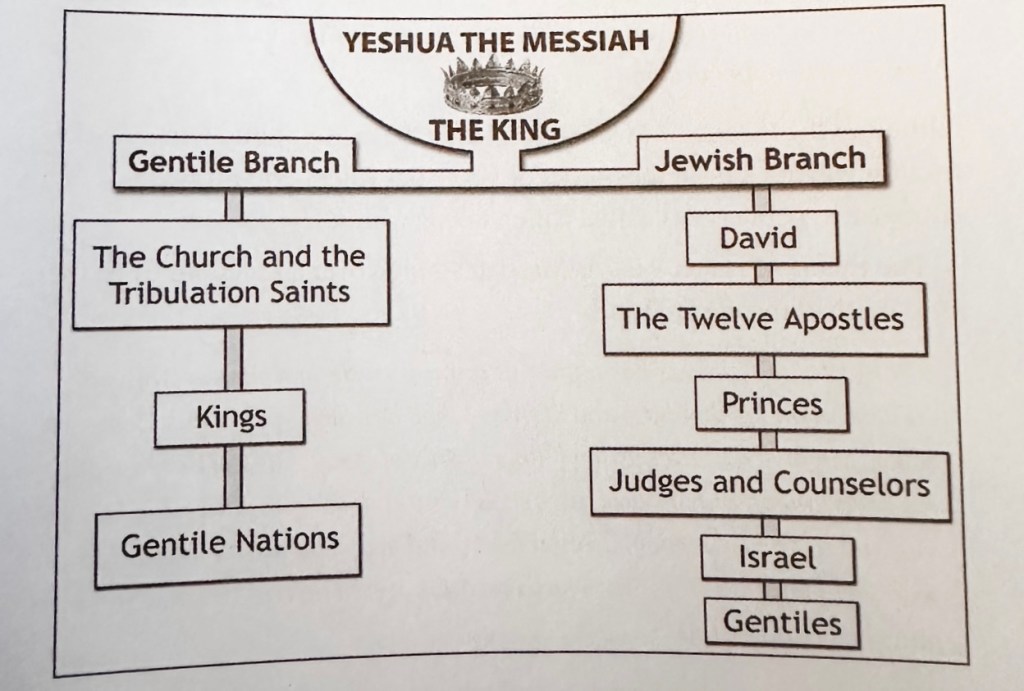
Revelation 20:4 reveals two groups that will make up the Gentile Branch. The first group is the Church Age saints seen in verse 4a, as the ones sitting on the thrones. “Then I saw thrones, and the people sitting on them had been given the authority to judge” (NLT). Although the Church is represented here as a whole, the vision in Revelation 20 occurs after they have already been judged at the Bema Seat Judgment (Judgment Seat of Christ) and are now given authority to judge. This is an important fact to remember because, as Fruchtenbaum states, “it is the outcome of this judgment [the Bema Seat Judgment] that will determine the position of each church saint in the kingdom” (The Footsteps of the Messiah, p. 386).
This quote by Fruchtenbaum is sobering. As a Church Age saint, I am reminded of Paul’s teaching in 1 Cor. 3:9-15, 2 Cor. 5:10-11, and Colossians 3:24-25. We need to be reminded of the implications of these passages. The Judgment Seat of Christ will be a time of affirmation for every faithful Christian, but those who have chosen to live their lives out of the energy of the flesh rather than the energy of the Spirit will suffer loss. This loss is NOT the loss of salvation, but the loss of REWARD.
LaHaye says, “If we take Paul’s words at face value, we must face the possibility of serious rebuke by Christ and a loss of rewards and privileges. John warned that we should live so that we will not “be ashamed before Him at His coming” (1 John 2:28, LaHaye Prophecy Bible, p. 1247). Everything that is done by grace through faith in our lives will be rewarded. The extent of the reward determines the degree of faithful believers’ role in ruling and reigning with Christ. Although all Christians will receive eternal life and experience the joys of the kingdom, not all Christians will have the same level of service to the King during the thousand-year reign.
If you are like me, you might feel a sense of dread or fear when processing this truth. However, we don’t have to fear judgment if we live surrendered to Christ! There is no condemnation in Him! But if you are feeling convicted of something, confess it right now to the Lord! It was King David’s repentant heart that set him apart to God and qualified him to rule Israel. By God’s grace, you can live the same way. Having our eyes fixed on Jesus is a purifying hope (1 John 3:1-3). I love this quote by Dillow:
“This view of the judgment seat should not lead to introspection. For most of us our inner life is confusing and full of mixed motives. How can we have any confidence to stand before Christ if we know that every word will be recalled and every deed evaluated? We can all identify with the apostle Paul when he said, “For I know that in me…nothing good dwells.” … “For the Christian who is walking in the light, even though he fails repeatedly, he has no need for concern. While even persevering disciples will have regrets and loss at the judgment seat, their predominant sense will be of joy and gratitude” (Dillow, The Reign of the Servant Kings, Kindle Edition quote).
The focus should be on Christ, not excessive introspection of our failures. When we have our eyes fixed on Him, He will take care of the rest. Paul offers much encouragement to the Philippian believers.
“Not that I have already obtained it or have already become perfect, but I press on so that I may lay hold of that for which also I was laid hold of by Christ Jesus. Brethren, I do not regard myself as having laid hold of it yet; but one thing I do: forgetting what lies behind and reaching forward to what lies ahead, I press on toward the goal for the prize of the upward call of God in Christ Jesus.”
Philippians 3:12-14 NASB95
The second group in the Gentile Branch of government is the Tribulation Saints. They are described in Revelation 20:4b as “the souls of those who had been beheaded for their testimony about Jesus and for proclaiming the word of God. They had not worshiped the beast or his statue, nor accepted the mark on their foreheads or their hands. They all come to life again, and they reigned with Christ for a thousand years” (Rev. 20:4b NLT).
“So then, both the church and the tribulation saints will co-reign with the King for one thousand years.”
Fruchtenbaum, The Footsteps of the Messiah, p. 386
The chain of command in the Gentile Branch of the Messianic government includes kings. We will study this more next week, but it is interesting to note that Psalm 72 mentions several kings (Tarshish, isles, Sheba, and Seba) offering gifts to King Jesus as well as all the kings from all the nations falling down before Him and serving Him during His Millennial reign (Ps. 72:10-11).
In conclusion, I want to bring us back to the Davidic Covenant. What a faithful God we serve! I am amazed at God’s covenant with David and how it reveals the heart of God not only for Israel but for us. The Church and Tribulation Saints will have an integral part in the Kingdom. How amazing to think that we will be part of the fulfillment of this amazing covenant.
Week 4 Homework Reflections:
Wow! If you made it this far, you are a trooper LOL! Here are some things to meditate on from this week’s study.
- Read 1 Samuel 8:10-20. What warnings did Samuel give about the way a king would rule over them?
- How was Israel’s desire to be like the other nations less than what God desired for them? How does this truth apply to us? What does God look for in a leader based on 1 Samuel 16:7?
- Read the following Scriptures and record everything God promised as part of the Davidic Covenant: 2 Samuel 7; 1 Chron. 17:11-14; 2 Chron. 6:16; Psalm 89
- What is Jesus called in Matthew 21:9? Read Jeremiah 23:5; Is. 9:7; 11:1-5; Acts 2:22-41; Acts 13:32-39; Luke 1:32, 69; Rev. 3:7. How is the Davidic Covenant fulfilled in Christ?
- Read 1 Cor. 3:9-15; 2 Cor. 5:10-11; Col. 3:24-25; and 1 John 2:28. List everything you learn about the Judgment Seat of Christ.
- How does Philippians 3:12-14 encourage you as a believer, especially if you are convicted of times in your past when you were not faithful to God? How does the truth in these verses apply to your life from this day forward?
For a deeper dive into the Bema Seat Judgment, see this post from earlier in our series.
 Simply Persuaded